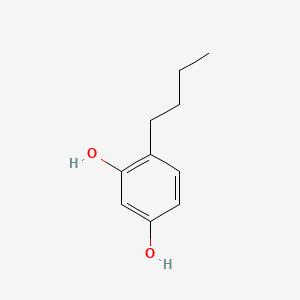
Description: 4-BUTYLRESORCINOL — ANTIOXIDANT.
All Functions: ANTIOXIDANT
Quick Facts:
- Category: active
Proven Benefits At A Glance:
- 4-butylresorcinol works by inhibiting tyrosinase, an enzyme involved in melanin production
- In a clinical study, a formula containing 4-butylresorcinol reduced brown spot count by 28.4% and brown spot area by 40.3% after 84 days of twice-daily use
- Research shows the ingredient can reduce melanin production in lab-grown skin by up to 67% within 21 days
- The ingredient has known skin irritancy concerns, which research is working to address through improved formulations
- Benefits were maintained for at least one month after stopping treatment in clinical testing
Safety tier is a starting heuristic from regulatory status and comedogenic rating, not a dermatological verdict — see our Terms for the full disclaimer. Research confidence reflects how many real cited studies back this ingredient, not the strength of their findings.
🧪 4-BUTYLRESORCINOL
4-BUTYLRESORCINOL
CAS Number: 18979-61-8
Also Known As: —
Category: active
Korean Name: 4-부틸레조시놀
1,3-Dihydroxy-4-N Butyl Benzene
4-BUTYLRESORCINOL is an active ingredient used in skincare formulations.
🌍 Regulatory Status
📊 Comedogenicity
📚 Research & Evidence
🔬 The Science
4-Butylresorcinol is a skin-lightening active ingredient that works at the cellular level. Here’s what the research shows:
#1: How it works — 4-butylresorcinol inhibits the activity of tyrosinase and dihydroxyindole carboxylate oxidase (J Mater Chem B, 2026), two enzymes central to melanin production in your skin. It may also suppress the expression of several melanin-related proteins, including tyrosinase, endothelin-1, mammalian target of rapamycin, and microphthalmia-associated transcription factor (J Mater Chem B, 2026). #2: Lab-based efficacy — When tested in reconstructed human skin tissue, a gel serum containing 4-butylresorcinol (along with tranexamic acid, niacinamide, phytic acid, and hydroxy acids) reduced melanin production by 50% within 14 days and 67% by day 21 (J Cosmet Dermatol, 2024).
In laboratory cell cultures, formulations can achieve melanin inhibition improvements of 1.55-fold compared to traditional oil-based versions (Pharmaceuticals (Basel), 2025). #3: Clinical results in humans with hyperpigmentation — In a 35-person study using twice-daily application for 84 days, the combination formula showed: brown spot count reduced by 28.4%, brown spot area reduced by 40.3%, melanin index reduced by 31.1%, overall pigmentation severity (mMASI) reduced by 63%, and skin luminosity increased by 79% (J Cosmet Dermatol, 2024). Clinical improvements appeared within 14 days and continued through day 84, with benefits maintained one month after stopping use (J Cosmet Dermatol, 2024). #4: Formulation challenges and solutions — The ingredient has known limitations: poor stability, low skin permeability, and high irritancy potential (Pharmaceuticals (Basel), 2025; J Mater Chem B, 2026).
Researchers have developed advanced formulations to address these issues. A deep eutectic solvent nanoparticle system showed a 3.46-fold increase in skin permeability and 1.53-fold improvement in 4-BR stability compared to traditional oil-based formulations (Pharmaceuticals (Basel), 2025). A supramolecular complex combining 4-butylresorcinol with licoricarketone A and vitamin E acetate demonstrated reduced skin irritancy while maintaining efficacy, reducing melanin content by 30.55% and inhibiting tyrosinase activity by 59.90% in testing (J Mater Chem B, 2026). #5: Safety profile — The gel serum formula demonstrated “very good skin tolerability” in the clinical study (J Cosmet Dermatol, 2024), though the ingredient itself carries irritancy concerns that manufacturers are actively working to minimize through formulation innovations (Pharmaceuticals (Basel), 2025; J Mater Chem B, 2026).
💧 Skin Type Compatibility
⚠️ Don’t Combine With
🧴 Products Containing 4-BUTYLRESORCINOL
📄 Related Research
Matched by search — not necessarily verified support for every statement above.
- Furmanczyk M et al. (2024). Efficacy and tolerability of a depigmenting gel serum comprising tranexamic acid, niacinamide, 4-butylresorcinol, phytic acid, and a mixture of hydroxy acids that targets the biological processes regulating skin melanogenesis. J Cosmet Dermatol.
- Han H et al. (2025). Self-Assembly 4-Butylresorcinol Deep Eutectic Solvent Nanoparticles for Efficient Transdermal Delivery and Whitening. Pharmaceuticals (Basel).
- Lu B et al. (2026). Co-delivery of loaded 4-butylresorcinol and licochalcone A in a supramolecular system for synergistic permeation and whitening effects. J Mater Chem B.
Similar Ingredients
📰 More News
-
Bakuchiol: From structural mimicry to systems-level skin biology
PubMed · Jun 2, 2026
-
Rosacea Skincare Including Moisturizers, Serums & Prescribed Creams
The Derm Review · Jun 4, 2026
-
The impact of avobenzone and oxybenzone on fibroblast and keratinocyte membranes. Searching for the role of lipids in the effect of UV filters on skin cells
PubMed · Jun 5, 2026
-
The Best Firming Tightening Anti Aging Body Lotions. For loss of firmness, crepey skin and wrinkles.
The Derm Review · Jun 12, 2026
-
14 of the Best Eczema Creams to Soothe Compromised Skin
The Derm Review · Jun 13, 2026
-
How To Get Rid of Age Spots, Dark Spots & Liver Spots on Hands, Arms, Legs, Body, Face
The Derm Review · Jun 13, 2026