2-MERCAPTONICOTINOYL GLYCINE
⚠️ Data is provided for informational purposes only. It may contain inaccuracies and should be independently verified. This is not medical advice. Consult a healthcare professional before making health decisions.

Description: 2-MERCAPTONICOTINOYL GLYCINE — SKIN CONDITIONING – MISCELLANEOUS.

All Functions: SKIN CONDITIONING – MISCELLANEOUS

Quick Facts:

  • Category: emollient

Proven Benefits At A Glance:

  • 2-Mercaptonicotinoyl glycine (2-MNG) is a new ingredient designed to reduce excessive skin pigmentation
  • Unlike many pigmentation fighters, it works by binding to melanin precursors rather than blocking the enzyme tyrosinase
  • In a clinical trial, a serum with 0.5% 2-MNG performed as well as hydroquinone 4% (the current gold standard) for melasma, with fewer irritating side effects
  • Research shows it can help prevent both immediate darkening and new melanin production triggered by UV exposure
  • Early evidence suggests it may also help protect against high-energy visible light (HEV) induced pigmentation
Safety: Generally Low ConcernResearch confidence: Good

Safety tier is a starting heuristic from regulatory status and comedogenic rating, not a dermatological verdict — see our Terms for the full disclaimer. Research confidence reflects how many real cited studies back this ingredient, not the strength of their findings.

🧪 2-MERCAPTONICOTINOYL GLYCINE

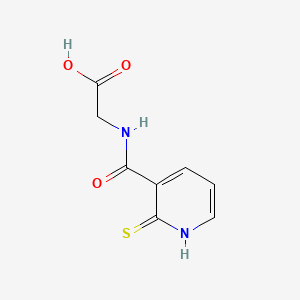
Chemical structure of 2-MERCAPTONICOTINOYL GLYCINE

2-MERCAPTONICOTINOYL GLYCINE

CAS Number: 2101538-28-5

Also Known As:

Category: emollient

Korean Name: 2-머캅토니코티노일글라이신

2-Mercaptonicotinoyl Glycine is the organic compound that conforms to the formula

2-MERCAPTONICOTINOYL GLYCINE is an emollient ingredient used in skincare formulations.

SKIN CONDITIONING – MISCELLANEOUS

🌍 Regulatory Status

EU: No restriction on fileUS: No restriction on file

📊 Comedogenicity

No data yet
Not rated for this ingredient yet.

📚 Research & Evidence

PUBMED CITATIONS
4
Data sources: EU CosIng PubMed

🔬 The Science

2-Mercaptonicotinoyl glycine is an innovative ingredient created through high-throughput screening and computational design (Pigment Cell Melanoma Res, 2024). The molecule was specifically engineered to balance effectiveness with a lower environmental water footprint compared to existing options. Here’s how it works differently from many current depigmentation products: #1: Instead of inhibiting tyrosinase—the enzyme that produces melanin—2-MNG uses a chemical process called covalent conjugation, where its thiol group attaches directly to melanin precursors (the building blocks of melanin), preventing them from being incorporated into growing melanin chains (Pigment Cell Melanoma Res, 2024; J Cosmet Dermatol, 2024). This means melanocytes (pigment-producing cells) remain intact and functional, addressing a key safety concern with some traditional depigmentation agents.

In a 3-month clinical trial involving 109 women with mild-to-severe melasma, a facial serum containing 0.5% 2-MNG applied twice daily achieved non-inferior efficacy to hydroquinone 4% (applied once daily), with an estimated difference in the Modified Melasma Area and Severity Index of only 0.46 points—well within the non-inferiority margin (Dermatol Ther (Heidelb), 2025). Notably, #2: both treatments showed statistically significant improvements starting by day 28, and quality-of-life measures (MELASQoL and PUSH-D scores) improved similarly in both groups by the end of treatment (Dermatol Ther (Heidelb), 2025). The key distinction emerged in tolerability: at day 28, only 6.0% of 2-MNG users experienced local skin reactions compared to 21.4% in the hydroquinone group (Dermatol Ther (Heidelb), 2025).

Beyond melasma, #3: a separate controlled study on melanin-rich skin exposed to UV daylight found that 2-MNG at 0.5% and 1% both significantly reduced immediate darkening and inhibited new melanin production, with the 1% concentration performing better than 0.5% (J Cosmet Dermatol, 2024). When combined with lipohydroxy acid (LHA) and Mexoryl-SX (a UV filter), 0.5% 2-MNG showed even stronger results, outperforming 4-n-butyl-resorcinol, another common depigmentation agent (J Cosmet Dermatol, 2024). Finally, #4: emerging evidence suggests protection beyond traditional UV radiation. In trials using high-energy visible (HEV) light—the blue-range light that can worsen hyperpigmentation—2-MNG at 0.5% and 1% produced an early and sustained decrease in HEV-induced pigmentation that was measurable by both instrument readings and visual assessment, whereas vitamin C (ascorbic acid 7%) did not show efficacy in this context (Front Pharmacol, 2025).

This positions 2-MNG as a potentially valuable addition to sun protection strategies, particularly as a non-tinted alternative to pigment-based blockers of visible light.

💧 Skin Type Compatibility

No data yet
Per-skin-type data isn’t curated for this ingredient yet.

⚠️ Don’t Combine With

No data yet
No known incompatibilities on file for this ingredient.

🧴 Products Containing 2-MERCAPTONICOTINOYL GLYCINE

📄 Related Research

Matched by search — not necessarily verified support for every statement above.

Similar Ingredients

(CINNAMOMUM CASSIA/MAGNOLIA OFFICINALIS) BARK/(ALPINIA OFFICINARUM/ANGELICA GIGAS) ROOT EXTRACT
active
View
1,2-HEPTANEDIOL
1,2-HEPTANEDIOL
emollient
View
2-METHYL-4-HYDROXYPYRROLIDINE
emollient
View
4-PCA DIMETHICONE
4-PCA DIMETHICONE
emollient
View
Update cookies preferences