
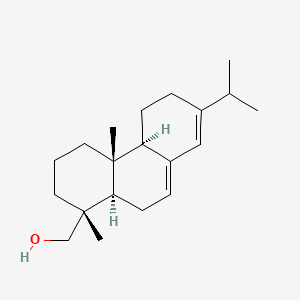
Description: ABIETYL ALCOHOL — VISCOSITY CONTROLLING.
All Functions: VISCOSITY CONTROLLING
Quick Facts:
- Category: other
Proven Benefits At A Glance:
- Abietyl alcohol is derived from abietic acid, a natural compound found in pine resin
- Most research on abietyl alcohol involves laboratory studies of synthesized versions, not finished skincare products
- Current evidence is limited to cell culture studies; human skin safety and efficacy data are not available in these sources
Safety tier is a starting heuristic from regulatory status and comedogenic rating, not a dermatological verdict — see our Terms for the full disclaimer. Research confidence reflects how many real cited studies back this ingredient, not the strength of their findings.
🧪 ABIETYL ALCOHOL
ABIETYL ALCOHOL
CAS Number: 666-84-2
Also Known As: —
Category: other
EC Number: 211-564-4
Korean Name: 아비에틸알코올
[1R-(1.alpha.,4a.beta.,4b.alpha.,10a.alpha.)]-1,2,3,4,4a,4b,5,6,10,10a-decahydro-7-isopropyl-1,4a-dimethylphenanthren-1-methanol
ABIETYL ALCOHOL is an other ingredient used in skincare formulations.
🌍 Regulatory Status
📊 Comedogenicity
📚 Research & Evidence
🔬 The Science
Abietyl alcohol is created through chemical reduction of abietic acid, a tricyclic diterpene (a type of natural plant compound) extracted from the oleoresin of Pinus longifolia Roxberghii pine trees (Pak J Pharm Sci, 2014). The available research focuses on laboratory-synthesized esters—chemical variants—of abietyl alcohol rather than the ingredient itself as typically used in skincare. In one study, researchers created twelve previously unreported abietyl alcohol esters and tested them against cancer cell lines in a laboratory setting using an assay called SRB (Pak J Pharm Sci, 2014). The research showed that #1: cell cycle progression changed in breast cancer (MCF7) and hepatocellular carcinoma (Huh7) cell lines after 48 and 72 hours of exposure (Pak J Pharm Sci, 2014).
However, these are preliminary findings from cells grown in dishes, not from human skin studies. The sources provided do not contain information about abietyl alcohol’s safety profile in skincare products, its effects on living human skin, or its cosmetic benefits. Any claims about this ingredient in consumer skincare should be viewed as largely unsupported by the current research base.
💧 Skin Type Compatibility
⚠️ Don’t Combine With
🧴 Products Containing ABIETYL ALCOHOL
📄 Related Research
Matched by search — not necessarily verified support for every statement above.
Similar Ingredients

📰 More News
-
Bakuchiol: From structural mimicry to systems-level skin biology
PubMed · Jun 2, 2026
-
Rosacea Skincare Including Moisturizers, Serums & Prescribed Creams
The Derm Review · Jun 4, 2026
-
The impact of avobenzone and oxybenzone on fibroblast and keratinocyte membranes. Searching for the role of lipids in the effect of UV filters on skin cells
PubMed · Jun 5, 2026
-
The Best Firming Tightening Anti Aging Body Lotions. For loss of firmness, crepey skin and wrinkles.
The Derm Review · Jun 12, 2026
-
14 of the Best Eczema Creams to Soothe Compromised Skin
The Derm Review · Jun 13, 2026
-
How To Get Rid of Age Spots, Dark Spots & Liver Spots on Hands, Arms, Legs, Body, Face
The Derm Review · Jun 13, 2026