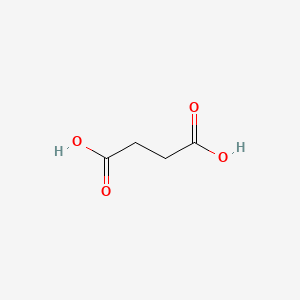
E363 – SUCCINIC ACID
CAS — · also known as E363 – Aċidu suċċiniku, E363 – Сукцинова киселина, E363 – Bernsteinsäure, E363 – Ηλεκτρικο οξυ, E363 – Kyselina jantárová, E363 – Borostyánkősav, E363 – Jantarna kislina, E363 – Kyselina jantarová, E363 – Ácido succínico, E363 – Gintaro rūgštis, E363 – Kwas bursztynowy, E363 – Ravsyre, E363 – Acido succinico, E363, E363 – Barnsteenzuur, E363 – Dzintarskābe, E363 – Acid succinic, E363 – Merevaikhape, E363 – Bärnstenssyra, E363 – Acide succinique, E363 – Meripihkahappo, E363 – Àcid succínic · other
E363 – SUCCINIC ACID is an other ingredient used in skincare formulations.
Quick facts
Quick Facts:
- Category: other
- Also Known As: E363 – Aċidu suċċiniku, E363 – Сукцинова киселина, E363 – Bernsteinsäure, E363 – Ηλεκτρικο οξυ, E363 – Kyselina jantárová, E363 – Borostyánkősav, E363 – Jantarna kislina, E363 – Kyselina jantarová, E363 – Ácido succínico, E363 – Gintaro rūgštis, E363 – Kwas bursztynowy, E363 – Ravsyre, E363 – Acido succinico, E363, E363 – Barnsteenzuur, E363 – Dzintarskābe, E363 – Acid succinic, E363 – Merevaikhape, E363 – Bärnstenssyra, E363 – Acide succinique, E363 – Meripihkahappo, E363 – Àcid succínic
Chemical Overview
Succinic acid appears as white crystals or shiny white odorless crystalline powder. pH of 0.1 molar solution: 2.7. Very acid taste. (NTP, 1992) Succinic acid is an alpha,-dicarboxylic acid resulting from the formal oxidation of each of the terminal methyl groups of butane to the corresponding carboxy group. It is an intermediate metabolite in the citric acid cycle. It has a role as a micronutrient, an anti-ulcer drug, a nutraceutical, a radiation protective agent and a fundamental metabolite. It is an alpha,omega-dicarboxylic acid and a C4-dicarboxylic acid. It is a conjugate acid of a succinate(1-). A water-soluble, colorless crystal with an acid taste that is used as a chemical intermediate, in medicine, the manufacture of lacquers, and to make perfume esters. It is also used in foods as a sequestrant, buffer, and a neutralizing agent. (Hawley’s Condensed Chemical Dictionary, 12th ed, p1099; McGraw-Hill Dictionary of Scientific and Technical Terms, 4th ed, p1851)
Source(s): CAMEO Chemicals, ChEBI, DrugBank, via PubChem
Comedogenicity
Similar Ingredients

📰 More News
-
The CCL20-CCR6 axis predominantly drives IL-17-mediated psoriasis while modestly contributing to papain-induced type 2 inflammation
PubMed · Jul 11, 2026
-
SkinCeuticals Just Reformulated Its C E Ferulic Serum
Allure · Jul 20, 2026
-
Are Sunscreen Oils Just Tanning Oils in Disguise? Experts Weigh In
Allure · Jul 20, 2026
-
Update to RIFM fragrance ingredient safety assessment, propenylguaethol, CAS Registry Number 94-86-0
PubMed · Jul 20, 2026
-
Earth Harbor Obscura Night Repair Concentrate Review
Allure · Jul 21, 2026
-
Okay, We’ll Bite: Fruity Perfumes Are Cool
Allure · Jul 21, 2026