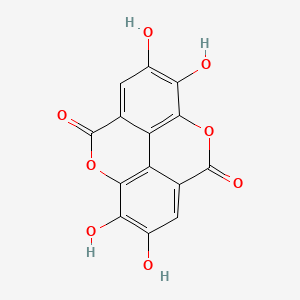
ELLAGIC ACID
CAS 476-66-4 · active · EC 207-508-3 · KR 엘라직애씨드
2,3,7,8-Tetrahydroxy-[1]-benzopyrano[5,4,3,-cde]-[1]-benzopyran-5,10-dione
ELLAGIC ACID is an active ingredient used in skincare formulations.
Quick facts
Description: ELLAGIC ACID — antioxidant, brightening.
All Functions: antioxidant, brightening
Quick Facts:
- Category: active
Proven Benefits At A Glance:
- Ellagic acid is a polyphenol found naturally in plants and vegetables, present either freely or as part of complex molecules called ellagitannins
- It has antioxidant and anti-inflammatory properties backed by multiple research studies
- Early research suggests potential benefits for hair growth, skin aging, wound healing, and protecting skin from UV damage
- Delivery into deeper skin layers remains a challenge that researchers are actively working to solve
- Most applications are still in research phases; more human studies are needed
Chemical Overview
Ellagic acid appears as cream-colored needles (from pyridine) or yellow powder. Odorless. (NTP, 1992) Ellagic acid is an organic heterotetracyclic compound resulting from the formal dimerisation of gallic acid by oxidative aromatic coupling with intramolecular lactonisation of both carboxylic acid groups of the resulting biaryl. It is found in many fruits and vegetables, including raspberries, strawberries, cranberries, and pomegranates. It has a role as an EC 2.7.7.7 (DNA-directed DNA polymerase) inhibitor, a geroprotector, an antioxidant, an EC 5.99.1.2 (DNA topoisomerase) inhibitor, an EC 5.99.1.3 [DNA topoisomerase (ATP-hydrolysing)] inhibitor, an EC 1.14.18.1 (tyrosinase) inhibitor, a food additive, an EC 2.5.1.18 (glutathione transferase) inhibitor, a plant metabolite, a fungal metabolite, an EC 2.3.1.5 (arylamine N-acetyltransferase) inhibitor, an EC 2.4.1.1 (glycogen phosphorylase) inhibitor, an EC 2.7.1.127 (inositol-trisphosphate 3-kinase) inhibitor, an EC 2.7.1.151 (inositol-polyphosphate multikinase) inhibitor, an EC 2.7.4.6 (nucleoside-diphosphate kinase) inhibitor and a skin lightening agent. It is a lactone, a polyphenol, a member of catechols, an organic heterotetracyclic compound and a cyclic ketone. It is functionally related to a gallic acid. It is a conjugate acid of an ellagic acid(2-). Ellagic acid is present in several fruits such as cranberries, strawberries, raspberries, and pomegranates. In pomegranates, there are several therapeutic compounds but ellagic acid is the most active and abundant. Ellagic acid is also present in vegetables. Ellagic acid is an investigational drug studied for treatment of Follicular Lymphoma (phase 2 trial), protection from brain injury of intrauterine growth restricted babies (phase 1 and 2 trial), improvement of cardiovascular function in adolescents who are obese (phase 2 trial), and topical treatment of solar lentigines. Ellagic acid’s therapeutic action mostly involves antioxidant and anti-proliferative effects.
Source(s): DrugBank, CAMEO Chemicals, ChEBI, via PubChem
Comedogenicity
Similar Ingredients

📰 More News
-
The CCL20-CCR6 axis predominantly drives IL-17-mediated psoriasis while modestly contributing to papain-induced type 2 inflammation
PubMed · Jul 11, 2026
-
SkinCeuticals Just Reformulated Its C E Ferulic Serum
Allure · Jul 20, 2026
-
Are Sunscreen Oils Just Tanning Oils in Disguise? Experts Weigh In
Allure · Jul 20, 2026
-
Update to RIFM fragrance ingredient safety assessment, propenylguaethol, CAS Registry Number 94-86-0
PubMed · Jul 20, 2026
-
Earth Harbor Obscura Night Repair Concentrate Review
Allure · Jul 21, 2026
-
Okay, We’ll Bite: Fruity Perfumes Are Cool
Allure · Jul 21, 2026