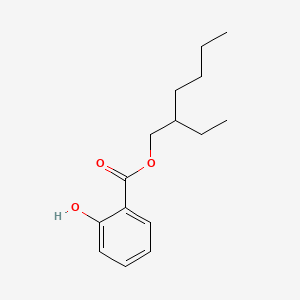
Description: ETHYLHEXYL SALICYLATE — chemical UV filter (UVB) — also known as Octisalate.
All Functions: chemical UV filter (UVB) — also known as Octisalate
Quick Facts:
- Category: sunscreen
Proven Benefits At A Glance:
- Ethylhexyl salicylate (EHS) is a UV filter used in sunscreens and other personal care products to protect skin from sun damage
- When applied to skin, EHS is absorbed and metabolized by the body, with traces appearing in urine within 10-11 hours
- In a study of 33 patients with frontal fibrosing alopecia (a type of hair loss), about 27% showed allergic contact dermatitis reactions to EHS in patch tests
- Human exposure to EHS has been increasing over the past 25 years based on biomonitoring data from Germany
- EHS is found in environmental water and wastewater, particularly in areas with heavy tourism or industry
Safety tier is a starting heuristic from regulatory status and comedogenic rating, not a dermatological verdict — see our Terms for the full disclaimer. Research confidence reflects how many real cited studies back this ingredient, not the strength of their findings.
🤰 Pregnancy Safety Note
Limited pregnancy data. Mineral sunscreens preferred.
🧪 ETHYLHEXYL SALICYLATE
ETHYLHEXYL SALICYLATE
CAS Number: 118-60-5
Also Known As: —
Category: sunscreen
EC Number: 204-263-4
Korean Name: 에칠헥실살리실레이트
2-Ethylhexyl salicylate
ETHYLHEXYL SALICYLATE is a sunscreen ingredient used in skincare formulations.
🌍 Regulatory Status
📊 Comedogenicity
📚 Research & Evidence
🔬 The Science
Ethylhexyl salicylate is a chemical UV filter—meaning it absorbs ultraviolet light to protect skin from sun damage. Here’s what research currently shows about how it behaves in and on your body:
#1: **Skin Absorption and Metabolism**: When EHS-containing sunscreen is applied to skin, the ingredient penetrates the outer layer and enters the bloodstream (Contact Dermatitis, 2024; Toxicol Lett, 2024; Arch Toxicol, 2024). After a single application of sunscreen to about 75% of body surface area, peak urinary excretion (the amount showing up in urine) occurred 10-11 hours later, with an elimination half-life between 6.6 and 9.7 hours (Arch Toxicol, 2024).
The body metabolizes EHS into several breakdown products; the unchanged EHS compound itself made up about 34% of what was excreted in urine within 24 hours, while various metabolites accounted for the rest (Toxicol Lett, 2024). Notably, the parent EHS compound remained the dominant marker even after metabolism, suggesting the body doesn’t completely break it down on first pass through the liver (Arch Toxicol, 2024). #2: **Potential for Allergic Reactions**: In a 2024 study, researchers patch-tested 33 women with frontal fibrosing alopecia (a condition involving progressive hair loss, typically on the forehead) using EHS at 10% concentration (Contact Dermatitis, 2024).
Nine patients—27.3% of the group—showed allergic contact dermatitis reactions to EHS. Four of these nine patients also reacted to their own personal sunscreens containing EHS. The mean age was 54 years (range 30-65). Five patients had already been diagnosed with hair loss before testing; four received their diagnosis during the investigation. The researchers propose that EHS should be added to the list of known contact allergens in this population, though they note EHS is “rarely reported as a sensitiser” overall (Contact Dermatitis, 2024). #3: **Population Exposure Trends**: A German biomonitoring study tracked EHS exposure markers in urine samples from young adults (ages 20-29) collected every 4 years between 1996 and 2020, all during winter months (Environ Int, 2023).
Detectable EHS metabolites increased dramatically: in 1996, only 5% of samples showed the most sensitive marker above the detection limit, but by 2016 this reached 100%. By 2020, levels remained high (97% above the detection limit). The median calculated daily intake of EHS was 59 micrograms per kilogram of body weight per day—well below regulatory safety thresholds (Environ Int, 2023). The study notes that higher exposures would be expected in people who use sunscreen more frequently, such as vacationers, children, and outdoor workers. #4: **Environmental Presence**: EHS is widely detected in surface water, wastewater, sediment, soil, air, and dust globally (Environ Res, 2026).
In surface water, mean concentrations averaged 203 ng/L along Romania’s Black Sea coast and varied by location based on tourism and industrial activity. The compound shows bioaccumulation potential—meaning it can build up in organisms over time—with a mean bioaccumulation factor of 1432 L/kg (Environ Res, 2026). In wastewater treatment systems, EHS concentrations ranged widely depending on whether it was dissolved or attached to particles (Environ Res, 2026).
💧 Skin Type Compatibility
Derived from this ingredient’s irritancy potential and comedogenicity rating against the needs of each skin type — e.g. oily and acne-prone skin are marked down for pore-clogging ingredients, sensitive skin for irritants. A starting heuristic, not a dermatological verdict.
⚠️ Don’t Combine With
🧴 Products Containing ETHYLHEXYL SALICYLATE
- Nivea, Nivea Sun Spray transparent protection invisible 30 haute
- Nivea Nivea q10 plus anti rides
- Beiesdorf, Nivea, Nivea Sun Protect & Hydrate 30 haute
- Nivea Q10 Plus Soin de jour FPS 15
- Nivea Sun Kids Lait Protecteur Format Voyage
- Nivea NIVEA Sun Protect & Hydrate SPF30 Zonnebrandspray
- BRYNILD GRUPPEN AS Nivea Day Care Q10 Plus C 50ml
- Nivea, Nivea Sun Sensitive Immediate Protect+, SPF30
- Balea Beauty Effect Tagescreme
- Sun Dance, Sundance Sonnenmilch 30 (hoch)
- dm sun dance 30 transparentes sonnenspray
- Sun dance, Sundance Sonnen light Lotion mit Kokosduft 20 mittel
- cien cien bb crème
- Cien VitalBeauty Dia
- Cien Sun Kids spray solaire
- Cien Cell Intense Cien
- Sundance, sun dance Transparentes Sonnenspray LSF 50
- Sun Dance, Sundance Sonnencreme-Gel Sport
- Sun Dance, Sundance Sonnenfluid sensitiv LSF 50+
- Sun Dance, Sundance sun dance 50+ Sonnenmilch
📄 Related Research
Matched by search — not necessarily verified support for every statement above.
- Pastor-Nieto MA et al. (2024). Sensitisation to ethylhexyl salicylate: Another piece of the frontal fibrosing alopecia puzzle. Contact Dermatitis.
- Kuhlmann L et al. (2024). New metabolites of 2-ethylhexyl salicylate in human urine after simulated real-life dermal sunscreen application. Toxicol Lett.
- Kuhlmann L et al. (2024). Toxicokinetics of 2-ethylhexyl salicylate (EHS) and its seven metabolites in humans after controlled single dermal exposure to EHS. Arch Toxicol.
- Chen J et al. (2026). A review of environmental occurrence and toxicity of 2-ethylhexyl salicylate, homomenthyl salicylate and ethylhexyl methoxycinnamate. Environ Res.
- Bury D et al. (2023). Increasing exposure to the UV filters octocrylene and 2-ethylhexyl salicylate in Germany from 1996 to 2020: Human biomonitoring in 24-h urine samples of the German Environmental Specimen Bank (ESB). Environ Int.
Similar Ingredients


📰 More News
-
The CCL20-CCR6 axis predominantly drives IL-17-mediated psoriasis while modestly contributing to papain-induced type 2 inflammation
PubMed · 23 days ago
-
SkinCeuticals Just Reformulated Its C E Ferulic Serum
Allure · 14 days ago
-
Are Sunscreen Oils Just Tanning Oils in Disguise? Experts Weigh In
Allure · 14 days ago
-
Update to RIFM fragrance ingredient safety assessment, propenylguaethol, CAS Registry Number 94-86-0
PubMed · 14 days ago
-
Earth Harbor Obscura Night Repair Concentrate Review
Allure · 13 days ago
-
Okay, We’ll Bite: Fruity Perfumes Are Cool
Allure · 13 days ago