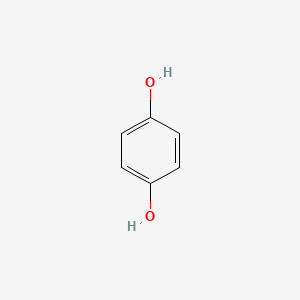
HYDROQUINONE
CAS 123-31-9 · active · EC 204-617-8
Hydroquinone
HYDROQUINONE is an active ingredient used in skincare formulations.
Quick facts
Description: HYDROQUINONE — skin lightening, tyrosinase inhibitor — EU-prohibited for general/OTC cosmetic use, permitted only in narrow professional contexts (see eu_restriction_note).
All Functions: skin lightening, tyrosinase inhibitor — EU-prohibited for general/OTC cosmetic use, permitted only in narrow professional contexts (see eu_restriction_note)
Quick Facts:
- Category: active
- Regulatory Note: Prohibited in the EU
Proven Benefits At A Glance:
- Hydroquinone is a skin-lightening agent used to treat melasma, post-inflammatory hyperpigmentation, age spots, and other pigmentation disorders
- It works by inhibiting tyrosinase, an enzyme involved in melanin production
- A U.S. ban on over-the-counter hydroquinone products has raised questions about its safety
- In clinical trials, hydroquinone reduced melasma severity by 33-43% over 90 days
- Alternative depigmenting agents like thiamidol and tranexamic acid show comparable effectiveness
- Hydroquinone use during breastfeeding is not well-studied; some experts recommend caution with long-term use
- Mild to moderate adverse effects have been reported in clinical studies
Chemical Overview
Hydroquinone appears as light colored crystals or solutions. May irritate the skin, eyes and mucous membranes. Mildly toxic by ingestion or skin absorption. Hydroquinone is a benzenediol comprising benzene core carrying two hydroxy substituents para to each other. It has a role as an antioxidant, a cofactor, a carcinogenic agent, a mouse metabolite, a human xenobiotic metabolite, an Escherichia coli metabolite and a skin lightening agent. It is a benzenediol and a member of hydroquinones. The CIR Expert Panel concluded that hydroquinone is safe at concentrations of less than or equal to 1% for cosmetic formulations designed for discontinuous, brief use followed by rinsing from the skin and hair. Hydroquinone is safe for use in nail adhesives and in artificial nail coatings, as a polymerization inhibitor, that are cured by LED light. Hydroquinone is unsafe for use in other leave-on cosmetic products.
Source(s): Cosmetic Ingredient Review (CIR), CAMEO Chemicals, ChEBI, via PubChem
Comedogenicity
Similar Ingredients

📰 More News
-
The CCL20-CCR6 axis predominantly drives IL-17-mediated psoriasis while modestly contributing to papain-induced type 2 inflammation
PubMed · Jul 11, 2026
-
SkinCeuticals Just Reformulated Its C E Ferulic Serum
Allure · Jul 20, 2026
-
Are Sunscreen Oils Just Tanning Oils in Disguise? Experts Weigh In
Allure · Jul 20, 2026
-
Update to RIFM fragrance ingredient safety assessment, propenylguaethol, CAS Registry Number 94-86-0
PubMed · Jul 20, 2026
-
Earth Harbor Obscura Night Repair Concentrate Review
Allure · Jul 21, 2026
-
Okay, We’ll Bite: Fruity Perfumes Are Cool
Allure · Jul 21, 2026