Mia Seilern
⚠️ Data is provided for informational purposes only. It may contain inaccuracies and should be independently verified. This is not medical advice. Consult a healthcare professional before making health decisions.

Description: PALMITOYL PENTAPEPTIDE-4 — peptide — supports collagen synthesis, anti-aging (Matrixyl).

All Functions: peptide — supports collagen synthesis, anti-aging (Matrixyl)

Quick Facts:

  • Category: active

Proven Benefits At A Glance:

  • Palmitoyl pentapeptide-4 (PPP-4) is a peptide ingredient studied for anti-aging effects
  • Research tested it on crow’s feet (fine lines around the eyes) in Asian skin
  • An 8-week study of 21 Indonesian women found improvements in some subjects using PPP-4
  • PPP-4 showed better results than both a placebo and another peptide (AHP-3) in this small trial
  • The ingredient was applied twice daily as a cream to the eye area
Safety: Generally Low ConcernResearch confidence: Fair

Safety tier is a starting heuristic from regulatory status and comedogenic rating, not a dermatological verdict — see our Terms for the full disclaimer. Research confidence reflects how many real cited studies back this ingredient, not the strength of their findings.

Pregnancy safe

🧪 PALMITOYL PENTAPEPTIDE-4

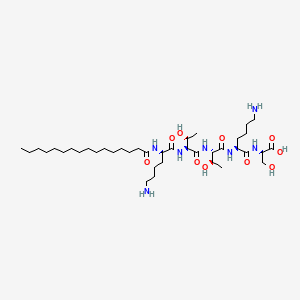
Chemical structure of PALMITOYL PENTAPEPTIDE-4

PALMITOYL PENTAPEPTIDE-4

CAS Number:

Also Known As:

Category: active

EC Number:

Korean Name: 팔미토일펜타펩타이드-4

Lysine, synthetic pentapeptide with serine, and threonine, hexadecanoyl derivatives

PALMITOYL PENTAPEPTIDE-4 is an active ingredient used in skincare formulations.

peptide — supports collagen synthesisanti-aging (Matrixyl)

🌍 Regulatory Status

EU: No restriction on fileUS: No restriction on file

📊 Comedogenicity

No data yet
Not rated for this ingredient yet.

📚 Research & Evidence

PUBMED CITATIONS
1
Data sources: EU CosIng PubMed

🔬 The Science

Palmitoyl pentapeptide-4 (PPP-4) is a topical peptide—a short chain of amino acids—designed to address visible signs of skin aging. A peptide is essentially a building block of proteins, and these shorter versions are used in skincare because they may be able to penetrate the skin more easily than full-sized proteins. The available research on PPP-4 comes from a small, controlled study published in the Journal of Clinical and Aesthetic Dermatology in 2023. This double-blind randomized trial (meaning neither the researchers nor participants knew who received which treatment) included 21 Indonesian female subjects ranging from 26 to 55 years old, studied over 8 weeks.

Researchers chose to focus on Asian skin specifically because #1: crow’s feet and aging signs can present differently across different genetic backgrounds, and #2: some anti-aging treatments carry a slightly higher risk of side effects or irritation in Asian skin compared to other populations (J Clin Aesthet Dermatol, 2023). Participants were split into three groups: one using a PPP-4 cream, one using a different peptide called Acetylhexapeptide-3 (AHP-3), and one using a placebo (inactive cream). Everyone applied their assigned cream twice daily to the periorbital area—the skin around the eyes where crow’s feet form. Researchers measured results using multiple methods: skin hydration (Corneometer), water loss (Tewameter), skin elasticity (Cutometer), digital photos, and a clinical grading scale specifically for crow’s feet severity.

The findings: improvements were observed in several subjects in both the PPP-4 and AHP-3 groups. However, #1: PPP-4 demonstrated better results compared to AHP-3 based on objective measurements, clinical photographs, and participants’ own assessments (J Clin Aesthet Dermatol, 2023). #2: PPP-4 also showed better results than placebo (J Clin Aesthet Dermatol, 2023). Important context: the researchers themselves noted this was an initial study and explicitly stated that “further study with a more adequate number of samples and duration” is needed (J Clin Aesthet Dermatol, 2023). With only 21 participants and 8 weeks of testing, this represents promising preliminary evidence rather than definitive proof of effectiveness.

💧 Skin Type Compatibility

100%
Sensitive
100%
Oily
100%
Dry
100%
Combination
100%
Acne-prone
100%
Normal

Derived from this ingredient’s irritancy potential and comedogenicity rating against the needs of each skin type — e.g. oily and acne-prone skin are marked down for pore-clogging ingredients, sensitive skin for irritants. A starting heuristic, not a dermatological verdict.

⚠️ Don’t Combine With

No data yet
No known incompatibilities on file for this ingredient.

🧴 Products Containing PALMITOYL PENTAPEPTIDE-4

📄 Related Research

Matched by search — not necessarily verified support for every statement above.

Similar Ingredients

(CINNAMOMUM CASSIA/MAGNOLIA OFFICINALIS) BARK/(ALPINIA OFFICINARUM/ANGELICA GIGAS) ROOT EXTRACT
active
View
3-GLYCERYL ASCORBATE
active
View
3-LAURYLGLYCERYL ASCORBATE
active
View
4-BUTYLRESORCINOL
4-BUTYLRESORCINOL
active
View
4-ISOBUTYLRESORCINOL
active
View
ABIES ALBA SEED EXTRACT
active
View
ABIES ALBA SEED OIL
ABIES ALBA SEED OIL
active
View
ACACIA CATECHU CATECHINS
active
View