
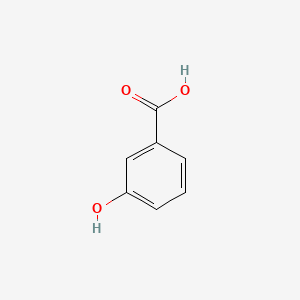
Description: 3-HYDROXYBENZOIC ACID — SKIN CONDITIONING.
All Functions: SKIN CONDITIONING
Quick Facts:
- Category: emollient
Proven Benefits At A Glance:
- 3-hydroxybenzoic acid (3-HBA) is an aromatic compound that can be produced from renewable resources like glucose and glycerol using engineered microbes
- Research shows 3-HBA may disrupt bacterial biofilm formation in lab studies
- 3-HBA is a precursor chemical for industrial materials, not yet established as a skincare ingredient
- Current research focuses on microbial production methods and antimicrobial properties—human skin safety data is extremely limited
Safety tier is a starting heuristic from regulatory status and comedogenic rating, not a dermatological verdict — see our Terms for the full disclaimer. Research confidence reflects how many real cited studies back this ingredient, not the strength of their findings.
🧪 3-HYDROXYBENZOIC ACID
3-HYDROXYBENZOIC ACID
CAS Number: 99-06-9
Also Known As: —
Category: emollient
EC Number: 202-726-5
Korean Name: 3-하이드록시벤조익애씨드
Benzoic Acid, 3- Hydroxy-
3-HYDROXYBENZOIC ACID is an emollient ingredient used in skincare formulations.
🌍 Regulatory Status
📊 Comedogenicity
📚 Research & Evidence
🔬 The Science
3-hydroxybenzoic acid (3-HBA) is an aromatic organic compound being studied primarily for industrial and antimicrobial applications rather than skincare. Here’s what the available research actually shows:
#1: Production and sourcing—Scientists are developing sustainable ways to manufacture 3-HBA from renewable feedstocks. One study (Eng Life Sci, 2019) demonstrated that engineered E. coli bacteria can convert glycerol into 3-HBA using a co-culture system, achieving a 5.3-fold improvement in production efficiency compared to single-strain cultures. Another approach (Microb Cell Fact, 2023) uses Corynebacterium glutamicum to produce related compounds from glucose. These are biotechnology achievements focused on replacing petroleum-based production. #2: Antimicrobial activity in controlled settings—The most skin-relevant finding comes from a 2025 study (Eur J Clin Microbiol Infect Dis) examining 3-HBA against Acinetobacter baumannii, a problematic antibiotic-resistant bacterium.
At a concentration of 0.078 mg/mL, 3-HBA reduced biofilm formation by roughly 60% in lab cultures and decreased bacterial biofilm material production by 58–64%. However, this research was conducted in test tubes and petri dishes, not on human skin. Importantly, the same study found that 3-HBA reduced viability of human cancer cells (MCF-7) by 43.67% at that same concentration, raising serious questions about safety for topical use on healthy skin. #3: Limited human or skin safety data—None of the sources provide evidence that 3-HBA is safe for application to human skin, effective for any skincare concern, or suitable for cosmetic use.
The research is purely mechanistic and microbial. The bottom line: 3-HBA is an interesting industrial and research chemical, but there is no skincare science behind it yet.
💧 Skin Type Compatibility
⚠️ Don’t Combine With
🧴 Products Containing 3-HYDROXYBENZOIC ACID
📄 Related Research
Matched by search — not necessarily verified support for every statement above.
- Nonaka K et al. (2023). A 4-hydroxybenzoate 3-hydroxylase mutant enables 4-amino-3-hydroxybenzoic acid production from glucose in Corynebacterium glutamicum. Microb Cell Fact.
- Zhou Y et al. (2019). Establishing microbial co-cultures for 3-hydroxybenzoic acid biosynthesis on glycerol. Eng Life Sci.
- Kuwabara K et al. (2026). Unprecedented Nitrite-Dependent Aromatic Amination to Synthesize 2,4-Diamino-3-Hydroxybenzoic Acid. Chembiochem.
- Pathoor NN et al. (2025). 3-Hydroxybenzoic acid inhibits the virulence attributes and disrupts biofilm production in clinical isolates of Acinetobacter baumannii. Eur J Clin Microbiol Infect Dis.
Similar Ingredients

📰 More News
-
Bakuchiol: From structural mimicry to systems-level skin biology
PubMed · Jun 2, 2026
-
Rosacea Skincare Including Moisturizers, Serums & Prescribed Creams
The Derm Review · Jun 4, 2026
-
The impact of avobenzone and oxybenzone on fibroblast and keratinocyte membranes. Searching for the role of lipids in the effect of UV filters on skin cells
PubMed · Jun 5, 2026
-
The Best Firming Tightening Anti Aging Body Lotions. For loss of firmness, crepey skin and wrinkles.
The Derm Review · Jun 12, 2026
-
14 of the Best Eczema Creams to Soothe Compromised Skin
The Derm Review · Jun 13, 2026
-
How To Get Rid of Age Spots, Dark Spots & Liver Spots on Hands, Arms, Legs, Body, Face
The Derm Review · Jun 13, 2026