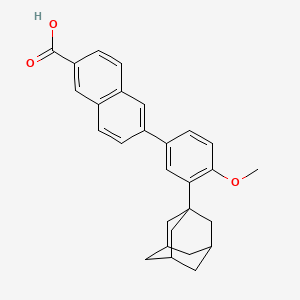
Adapalene
CAS — · also known as Differin · active
Adapalene is an active ingredient used in skincare formulations.
Quick facts
Description: Adapalene — acne treatment, retinoid.
All Functions: acne treatment, retinoid
Quick Facts:
- Category: active
- Also Known As: Differin
- Comedogenic Rating: 0/5
Proven Benefits At A Glance:
- Adapalene is a topical retinoid (vitamin A derivative) FDA-approved for treating acne
- It works by controlling cell proliferation and differentiation, and has anti-inflammatory properties
- When used topically, it’s poorly absorbed into the bloodstream—blood levels stay below 0.25 mcg/L even with long-term use
- Common mild-to-moderate side effects early on include redness, dryness, itching, and stinging
- It’s effective as a single treatment for mild comedonal acne, and works better for moderate acne when combined with benzoyl peroxide
- It has potential off-label uses beyond acne, though these are less established
Chemical Overview
Adapalene is a naphthoic acid that is CD437 in which the phenolic hydroxy group has been converted to its methyl ether. It has a role as a non-steroidal anti-inflammatory drug, a dermatologic drug and an EC 2.7.11.22 (cyclin-dependent kinase) inhibitor. It is a monocarboxylic acid, a naphthoic acid and a member of adamantanes. It is functionally related to a CD437. Acne vulgaris is a multifactorial disorder of the pilosebaceous unit involving increased sebum production, inflammation, and hyperproliferation/hyperkeratinization of the follicular infundibulum. It is also associated with Cutibacterium acnes (also known as Propionibacterium acnes). Adapalene is a third-generation topical retinoid used for the treatment of acne vulgaris. Adapalene has similar efficacy but a superior safety profile compared to tretinoin. [Tazarotene] is more efficacious than adapalene but is designated as pregnancy category X and hence is contraindicated in pregnant women. Adapalene can also be combined with benzoyl peroxide (BPO), which possesses bactericidal properties, and either adapalene alone, or adapalene BPO combination products, are commonly used to treat mild-to-severe acne. Differin®, produced by Galderma Labs, was first granted FDA approval on May 31st, 1996, as a 0.1% adapalene topical solution. Differin was later made available as 0.1% gel, cream, or lotion, or 0.3% gel products. On December 8th, 2008, Galderma Labs gained FDA approval for Epiduo®, a 0.1% adapalene, 2.5% BPO combination gel. Adapalene is a Retinoid.
Source(s): DrugBank, FDA Pharm Classes, ChEBI, via PubChem
Comedogenicity
0/5
Similar Ingredients

📰 More News
-
The CCL20-CCR6 axis predominantly drives IL-17-mediated psoriasis while modestly contributing to papain-induced type 2 inflammation
PubMed · Jul 11, 2026
-
SkinCeuticals Just Reformulated Its C E Ferulic Serum
Allure · Jul 20, 2026
-
Are Sunscreen Oils Just Tanning Oils in Disguise? Experts Weigh In
Allure · Jul 20, 2026
-
Update to RIFM fragrance ingredient safety assessment, propenylguaethol, CAS Registry Number 94-86-0
PubMed · Jul 20, 2026
-
Earth Harbor Obscura Night Repair Concentrate Review
Allure · Jul 21, 2026
-
Okay, We’ll Bite: Fruity Perfumes Are Cool
Allure · Jul 21, 2026