Mia Seilern
PALMITOYL TRIPEPTIDE-1
⚠️ Data is provided for informational purposes only. It may contain inaccuracies and should be independently verified. This is not medical advice. Consult a healthcare professional before making health decisions.

Description: PALMITOYL TRIPEPTIDE-1 — peptide, supports collagen production, anti-aging.

All Functions: peptide, supports collagen production, anti-aging

Quick Facts:

  • Category: active

Proven Benefits At A Glance:

  • Palmitoyl tripeptide-1 (PT-1) is a peptide ingredient studied for its role in collagen production
  • Research shows PT-1 works best when applied at night, aligning with skin’s natural nighttime collagen synthesis
  • A clinical trial of 30 women using nighttime PT-1 (paired with daytime baicalin) showed improvements in skin firmness, luminance, and fine lines
  • The ingredient appears to support the skin’s circadian rhythm — the body’s natural 24-hour cycle that regulates many processes
Safety: Generally Low ConcernResearch confidence: Fair

Safety tier is a starting heuristic from regulatory status and comedogenic rating, not a dermatological verdict — see our Terms for the full disclaimer. Research confidence reflects how many real cited studies back this ingredient, not the strength of their findings.

Pregnancy safe

🧪 PALMITOYL TRIPEPTIDE-1

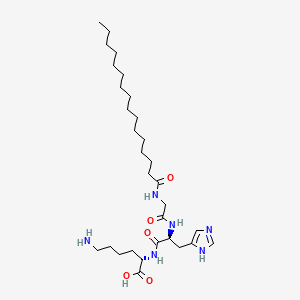
Chemical structure of PALMITOYL TRIPEPTIDE-1

PALMITOYL TRIPEPTIDE-1

CAS Number: 147732-56-7

Also Known As:

Category: active

EC Number: ,

Korean Name: 팔미토일트라이펩타이드-1

L-Lysine, N-(1-oxohexadecyl)glycyl-L-histidyl-

PALMITOYL TRIPEPTIDE-1 is an active ingredient used in skincare formulations.

peptidesupports collagen productionanti-aging

🌍 Regulatory Status

EU: No restriction on fileUS: No restriction on file

📊 Comedogenicity

No data yet
Not rated for this ingredient yet.

📚 Research & Evidence

PUBMED CITATIONS
1
Data sources: EU CosIng PubMed

🔬 The Science

Palmitoyl tripeptide-1 is a synthetic peptide — a short chain of amino acids — designed to interact with skin cells called fibroblasts, which are responsible for making and maintaining collagen, the protein that keeps skin firm and structured. According to research published in the Journal of Cosmetic Dermatology (2026), human skin fibroblasts follow a circadian rhythm, meaning their collagen-related activity fluctuates across the 24-hour day-night cycle. Specifically, genes involved in collagen synthesis and secretion (the production and release of new collagen) peak at night, while genes controlling collagen assembly and cross-linking peak during the day. This discovery led researchers to test whether timing ingredient application to match these natural rhythms could be more effective.

#1: PT-1 was applied at night in the study because nighttime is when fibroblasts naturally ramp up collagen synthesis and secretion (J Cosmet Dermatol, 2026). In laboratory fibroblast models, PT-1 boosted these nighttime synthesis processes. #2: In a clinical trial involving 30 female participants who used the nighttime PT-1 regimen (paired with daytime baicalin) for 8 weeks, skin showed measurable improvements: luminance increased by 16.29%, nasolabial fold depth (the depth of lines running from nose to mouth) decreased by 36.35%, and skin firmness increased by 24.35% as measured by R2 (J Cosmet Dermatol, 2026). It’s worth noting that the clinical evidence comes from a single, relatively small study, and PT-1 was tested as part of a time-coordinated two-ingredient system rather than in isolation, so its independent contribution cannot be fully separated from the daytime ingredient (baicalin).

💧 Skin Type Compatibility

100%
Sensitive
100%
Oily
100%
Dry
100%
Combination
100%
Acne-prone
100%
Normal

Derived from this ingredient’s irritancy potential and comedogenicity rating against the needs of each skin type — e.g. oily and acne-prone skin are marked down for pore-clogging ingredients, sensitive skin for irritants. A starting heuristic, not a dermatological verdict.

⚠️ Don’t Combine With

No data yet
No known incompatibilities on file for this ingredient.

🧴 Products Containing PALMITOYL TRIPEPTIDE-1

📄 Related Research

Matched by search — not necessarily verified support for every statement above.

Similar Ingredients

ACETYL HEXAPEPTIDE-8
active
View
ACETYL OCTAPEPTIDE-3
active
View
ACETYL TETRAPEPTIDE-5
active
View
ADENOSINE
ADENOSINE
active
View
ASTAXANTHIN
ASTAXANTHIN
active
View
Bakuchiol
Bakuchiol
active
View
COPPER TRIPEPTIDE-1
COPPER TRIPEPTIDE-1
active
View
DIPALMITOYL HYDROXYPROLINE
active
View