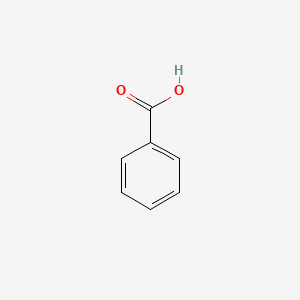
BENZOIC ACID
CAS 65-85-0 · preservative · EC 200-618-2 · KR 벤조익애씨드
Benzoic acid
BENZOIC ACID is a preservative ingredient used in skincare formulations.
Quick facts
Description: BENZOIC ACID — preservative.
All Functions: preservative
Quick Facts:
- Category: preservative
Proven Benefits At A Glance:
- Benzoic acid is a preservative and fragrance ingredient naturally found in plants and some animal tissues
- It’s used in cosmetics, foods, and pharmaceuticals to prevent bacterial and fungal growth
- Safety assessments conclude it’s safe at concentrations currently used in cosmetic products
- Your body breaks it down relatively quickly and excretes it as a compound called hippuric acid
- Can cause skin irritation or contact reactions in some people at higher concentrations
Chemical Overview
Benzoate is the simplest member of the class of benzoates that is the conjugate base of benzoic acid, comprising a benzoic acid core with a proton missing to give a charge of -1. It has a role as a plant metabolite and a human xenobiotic metabolite. It is a conjugate base of a benzoic acid. Benzoic acid, C6H5COOH, is a colourless crystalline solid and the simplest aromatic carboxylic acid. Benzoic acid occurs naturally free and bound as benzoic acid esters in many plant and animal species. Appreciable amounts have been found in most berries (around 0.05%). Cranberries contain as much as 300-1300 mg free benzoic acid per kg fruit. Benzoic acid is a fungistatic compound that is widely used as a food preservative. It often is conjugated to glycine in the liver and excreted as hippuric acid. Benzoic acid is a byproduct of phenylalanine metabolism in bacteria. It is also produced when gut bacteria process polyphenols (from ingested fruits or beverages). See also: Sodium Benzoate (annotation moved to).
Source(s): Toxin and Toxin Target Database (T3DB), PubChem, ChEBI, via PubChem
Comedogenicity
Similar Ingredients

📰 More News
-
The CCL20-CCR6 axis predominantly drives IL-17-mediated psoriasis while modestly contributing to papain-induced type 2 inflammation
PubMed · Jul 11, 2026
-
SkinCeuticals Just Reformulated Its C E Ferulic Serum
Allure · Jul 20, 2026
-
Are Sunscreen Oils Just Tanning Oils in Disguise? Experts Weigh In
Allure · Jul 20, 2026
-
Update to RIFM fragrance ingredient safety assessment, propenylguaethol, CAS Registry Number 94-86-0
PubMed · Jul 20, 2026
-
Earth Harbor Obscura Night Repair Concentrate Review
Allure · Jul 21, 2026
-
Okay, We’ll Bite: Fruity Perfumes Are Cool
Allure · Jul 21, 2026