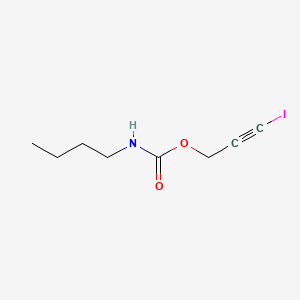
IODOPROPYNYL BUTYLCARBAMATE
CAS 55406-53-6 · preservative · EC 259-627-5 · KR 아이오도프로피닐부틸카바메이트
3-Iodo-2-propynyl butylcarbamate
IODOPROPYNYL BUTYLCARBAMATE is a preservative ingredient used in skincare formulations.
Quick facts
Description: IODOPROPYNYL BUTYLCARBAMATE — preservative.
All Functions: preservative
Quick Facts:
- Category: preservative
Proven Benefits At A Glance:
- IPBC is a preservative that kills bacteria and fungi, used in cosmetics, paints, wood treatments, and metalworking fluids
- It’s a broad-spectrum preservative, meaning it fights many types of microorganisms
- The EU has restricted how much IPBC can be used in cosmetics due to concerns about iodine release
- Some people develop allergic contact dermatitis (skin irritation) from IPBC exposure
- IPBC may be a concern for people already allergic to iodine-based products
Chemical Overview
3-iodo-2-propynyl butylcarbamate is an off-white solid. 3-iodoprop-2-yn-1-yl butylcarbamate is a carbamate ester that is carbamic acid in which the nitrogen has been substituted by a butyl group and in which the hydrogen of the carboxy group is replaced by a 1-iodoprop-2-yn-3-yl group. A fungicide, it is used as a preservative and sapstain control chemical in wood products and as a preservative in adhesives, paints, latex paper coating, plastic, water-based inks, metal working fluids, textiles, and numerous consumer products. It has a role as a xenobiotic, an environmental contaminant and an antifungal agrochemical. It is a carbamate ester, an organoiodine compound, an acetylenic compound and a carbamate fungicide. On the basis of the data presented in this report, the CIR Expert Panel concludes that Iodopropynyl Butylcarbamate (IPBC) is safe as a cosmetic ingredient at concentrations ≤ 0.1%. IPBC should not be used in products intended to be aerosolized.
Source(s): Cosmetic Ingredient Review (CIR), CAMEO Chemicals, ChEBI, via PubChem
Comedogenicity
Similar Ingredients

📰 More News
-
The CCL20-CCR6 axis predominantly drives IL-17-mediated psoriasis while modestly contributing to papain-induced type 2 inflammation
PubMed · Jul 11, 2026
-
SkinCeuticals Just Reformulated Its C E Ferulic Serum
Allure · Jul 20, 2026
-
Are Sunscreen Oils Just Tanning Oils in Disguise? Experts Weigh In
Allure · Jul 20, 2026
-
Update to RIFM fragrance ingredient safety assessment, propenylguaethol, CAS Registry Number 94-86-0
PubMed · Jul 20, 2026
-
Earth Harbor Obscura Night Repair Concentrate Review
Allure · Jul 21, 2026
-
Okay, We’ll Bite: Fruity Perfumes Are Cool
Allure · Jul 21, 2026